How to Start a Faceless YouTube Shorts Channel in 2026
Start a faceless YouTube Shorts channel in 2026: pick a niche, build a pipeline, hit YPP thresholds before the Feb 2027 change, and avoid demonetization.
Published 11 min readBy the WestSideAgency team
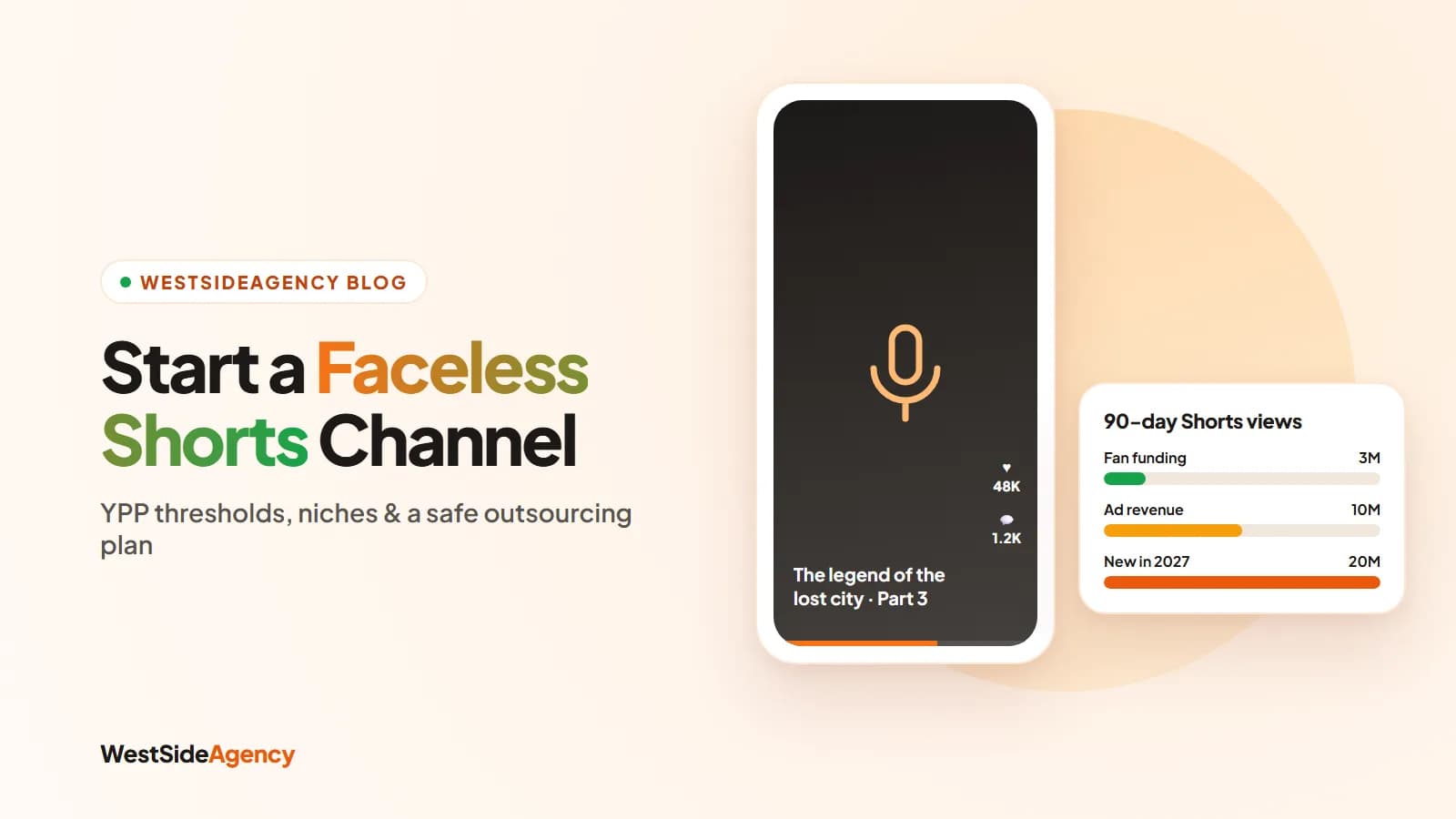
Faceless YouTube Shorts channels still work in 2026, but the rules have changed. On 1 February 2027, YouTube doubles the Shorts views new creators need to join the Partner Program and adds a monthly views requirement for earning from Shorts at all. YouTube has also tightened how it treats templated and mass-produced videos. This guide covers the numbers that matter, how to pick a niche that survives policy review, how to build a production pipeline, and how to outsource videos without breaking the reused-content rules.
The numbers that matter
10M
qualified Shorts views in 90 days to join YPP today
20M
needed by new creators from 1 Feb 2027
45%
of allocated Shorts revenue kept by creators
What “faceless” means in 2026
A faceless channel is one where you never appear on camera: narration over visuals, animation, text-led stories or edited stock footage. YouTube doesn’t penalise channels for being faceless. It reviews “your channel as a whole” for originality. What gets channels demonetised is content that looks mass-produced, not the absence of a face.
The monetization rules you’re actually playing by
Today’s two tiers
| Tier | Requirements | What it unlocks |
|---|---|---|
| Fan funding & Shopping | 500 subscribers, 3 public uploads in 90 days, and 3,000 watch hours in 12 months or 3M Shorts views in 90 days | Memberships, Super Chat, Super Thanks, Shopping |
| Ad revenue sharing | 1,000 subscribers and 4,000 watch hours in 12 months, or 10M qualified Shorts views in 90 days | A share of Shorts Feed and long-form ad revenue |
What changes on 1 February 2027
- New creators need 1,000 subscribers plus 8,000 watch hours in 365 days, or 20M qualified Shorts views in 90 days. Creators already in YPP aren’t affected.
- To earn from the Shorts Creator Pool in any month, a channel needs at least 10M qualified Shorts views in the previous 90 days.
- Channels must stay active (for example, 5 Shorts every 90 days), and creators must accept the new terms in YouTube Studio by 31 January 2027.
Views vs “engaged” views
Since March 2025, the public Shorts view counter includes every play and replay. YouTube says YPP eligibility and revenue sharing are based on engaged or qualified views instead, so the number under your video overstates your progress. Track qualified views in YouTube Studio.
Honest earnings math
Shorts ad revenue is pooled, and creators keep 45% of what’s allocated to them based on their share of engaged views. YouTube publishes no official Shorts RPM; vidIQ estimates most creators earn $0.03–$0.10 per 1,000 views, and AIR Media-Tech’s data puts the median at about $0.07–$0.20 in most niches, with US audiences paying far more than others. At those rates, 10 million views earns roughly $300 to $2,000. Shorts are a growth engine first and an income stream second.
Step 1: Pick a niche that survives policy review
YouTube’s inauthentic content policy (renamed from “repetitious content” in July 2025) specifically lists “image slideshows, templated storylines, or scrolling text with minimal or no narrative” and “characters … put in the same situation over and over again with the same outcome”. A series following the same characters across episodes is allowed. Choose a niche where you can make every video genuinely different.
| Niche | Policy watch-out | How to stay original |
|---|---|---|
| Kids stories | Made-for-kids content loses personalised ads and comments | Original stories and recurring characters, not one template |
| Horror & mystery | Realistic AI scenes need disclosure | Strong narration and a distinct voice |
| Motivational | Recycled speeches and quotes are reused content | Your own scripts with a clear point of view |
| Sports | Match footage triggers Content ID claims | Animation, stats and commentary instead of broadcast clips |
| History & mythology | Static image slideshows are named in the policy | Animated scenes and a narrative arc |
| Fake text stories | Scrolling text with little narrative is named in the policy | Voiced, plotted stories with varied endings |
Step 2: Set up the channel
Choose a name and handle that fit the niche, add a banner and profile image, and set your audience correctly. If your videos are made for kids, you must say so, which removes personalised ads and comments. Set default upload settings in YouTube Studio so every Short starts with the right category, language and description template.
Step 3: Build your production pipeline
- Script for the first second. Metricool found average Shorts view duration fell to about 16 seconds in 2026, so open with the hook, not an intro.
- Voice. Human or AI narration both work. YouTube doesn’t require disclosure for cloning your own voice for voice-overs or for AI-assisted scripts, but it does require it for realistic AI content such as real people or real-looking events. Disclosure itself “won’t limit a video’s audience or impact its eligibility to earn money.”
- Visuals. Make sure you have commercial-use rights for every clip, image, font and music track.
- Length. Shorts can run up to 3 minutes, but Shorts longer than 1 minute with a Content ID claim are blocked.
Step 4: Cadence and your first 90 days
Metricool’s analysis of nearly 800,000 videos suggests 2–4 Shorts a week as a sustainable baseline, scaling up only if quality holds. Expect a slow start: vidIQ’s study of 448,000 new channels found a first Short got a median of about 1,360 views in 30 days, with breakouts coming from a few outlier videos rather than steady growth.
Step 1: Weeks 1–4
Publish 2–4 Shorts a week and test different hooks and formats within your niche.
Step 2: Weeks 5–8
Double down on the formats with the best retention; cut what doesn’t work.
Step 3: Weeks 9–13
Turn winners into a recurring series and repurpose them for TikTok and Reels.
Outsourcing Shorts without breaking reused-content rules
Buying videos is allowed, but YouTube’s rules are specific:
“You cannot monetize third-party content that you’ve purchased unless its rights owner grants you commercial use rights.”
The reused content policy also rules out “content uploaded many times by other creators”, so a video pack sold to dozens of channels is a demonetisation risk however good it looks. Before you buy from any provider, including us, check:
Step 1: Made for you, not resold
Ask in writing whether your videos are produced for your channel only.
Step 2: Written commercial-use rights
Get explicit permission to monetize the videos.
Step 3: A unique script every time
Different stories and outcomes, not one template with new words.
Step 4: Your own layer on top
Add your hook, voice-over, captions or edit so the channel has a recognisable identity.
Step 5: Disclose realistic AI
Use YouTube’s altered-content setting whenever it applies.
Used this way, outsourcing is simply extra production capacity. Our YouTube Shorts packs cover niches like horror, history, mythology, motivation, sports and kids stories, and the same videos can be adapted for TikTok and Reels. For longer videos, see 2D animation. Ask us about exclusivity and usage rights before you order.
Beyond the Shorts pool: other ways to earn
- Fan funding and Shopping from 3M Shorts views in 90 days
- Affiliate links in descriptions and pinned comments
- Brand deals once your audience is clearly defined
- Long-form videos: AIR Media-Tech’s data shows Shorts RPM is only 3–14% of long-form RPM in most niches, so use Shorts to feed longer content
Six mistakes that get faceless channels demonetised
- Templated AI videos that differ only in their titles
- Static image slideshows with a robotic voice
- Compilations of clips from other platforms
- Resold video packs that other channels also upload
- Undisclosed realistic AI content
- Unlicensed music or sports footage
Build a channel YouTube would recognise as yours, and the rule changes become something to plan for rather than something to fear.