How to Start a Proxy Business in 2026: A Practical Reseller Guide
Start a proxy reseller business in 2026: pick a provider, model real margins with current per-GB prices, automate delivery via API and stay compliant.
Published 11 min readBy the WestSideAgency team
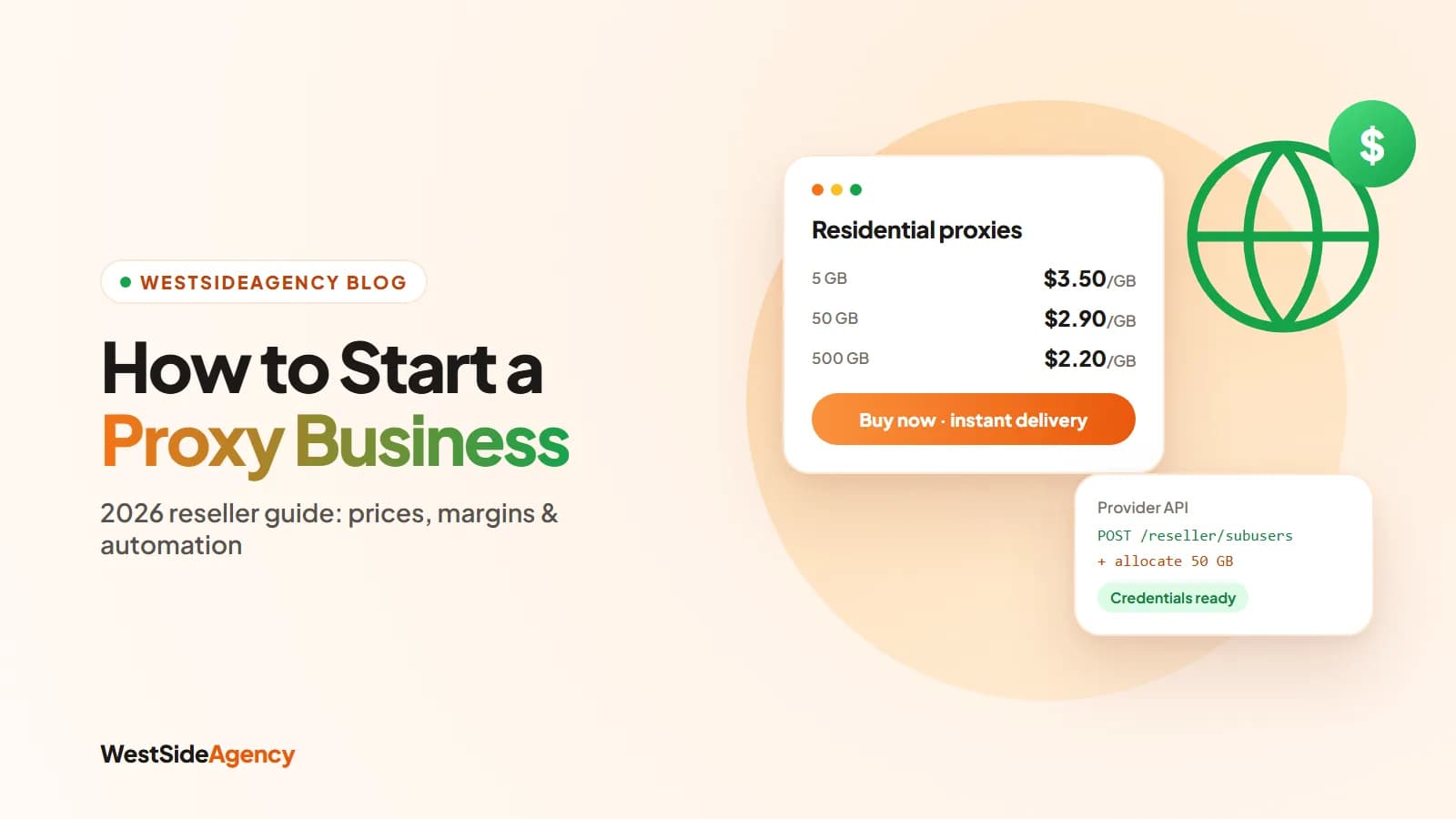
Most people who start a proxy business in 2026 don’t build a proxy network. They become a white-label reseller: they buy bandwidth wholesale from an established provider, sell it under their own brand, and earn the difference. You need four things to do it well: a trustworthy upstream provider, a storefront that delivers proxies automatically, a way to take payments, and a clear set of rules for your customers.
This guide walks through each one with current 2026 prices, a realistic profit example and the compliance questions most guides skip.
What a proxy business actually is
A proxy routes a customer’s traffic through another IP address. Businesses buy proxies to monitor prices, track search rankings, verify ads and collect public web data at scale. When you “start a proxy business”, you choose where in that supply chain you sit.
| Model | Upfront cost | Who owns the customer | How you earn |
|---|---|---|---|
| Affiliate | None | The provider | Referral commission |
| Reseller | Low (a deposit) | You | Spread between wholesale and retail price |
| White-label reseller | Low to medium (storefront) | You, under your own brand | Spread, plus higher retention |
| Own network | High (servers, IP sourcing) | You | Full margin, full risk |
Proxyway’s 2026 market research found that the market “supports only 10 to 15 companies with their own networks”, and that residential vendors are “predominantly white labels”. In other words, the white-label model isn’t a shortcut. It is how most of the industry already works.
Is selling proxies legal?
Reselling proxies through an official reseller or white-label program is a legitimate business model, and the providers that run those programs publish them openly. The legal risk sits in two places: how the IP addresses were sourced, and how your customers use them.
What providers will ask of you
- Know-your-customer checks. DataImpulse requires resellers to complete a KYC form and sign a reseller agreement. Bright Data’s KYC can include a short video call, and Oxylabs says it rejects at least a quarter of customer enquiries each year.
- Terms that flow down to your customers. Databay, for example, requires your end-user agreement to be at least as restrictive as its own policies, and leaves checkout, billing, tax, support and end-user controls with you.
- Banned uses. Typical reseller rules ban illegal activity, restricted financial targets, spam and reselling to other resellers without approval.
Why sourcing matters more than ever
In January 2026 Google’s Threat Intelligence Group disrupted IPIDEA, a residential proxy network whose SDKs enrolled user devices without clear consent, cutting its device pool “by millions”. In July 2026 it acted against NetNut, stating it has “high confidence that many popular residential proxy brands are in fact whitelabeling the NetNut botnet.” If your upstream pool is taken down, every brand built on top of it goes down with it.
Step 1: Choose your niche and proxy types
Each proxy type has a different cost structure and billing unit, so decide early what you’ll sell.
| Type | Typical billing | 2026 benchmark | Good for |
|---|---|---|---|
| Residential (rotating) | Per GB | Median $3.75/GB at 5 GB, $2.25 at 500 GB | Scraping, price monitoring, SEO |
| Datacenter / IPv4 | Per GB or per IP | From about $0.38–$0.60/GB, dedicated IPs from $2.50 | High-volume, speed-sensitive tasks |
| Mobile | Per line / month | Coronium’s 2026 example resells US lines at $161/month | Social and app testing, hardest targets |
Because networks are largely interchangeable (Proxyway calls building a moat “nearly impossible”), your edge is positioning, not the IPs. Pick a group you understand: e-commerce sellers tracking competitors, SEO agencies running rank trackers, or data teams that need a reliable, well-documented supplier. Speak their language, publish guides for their use case, and offer support in their time zone.
Step 2: Pick an upstream provider
Your provider is your factory. Before you sign up, check:
- Ethical sourcing. Ask how residential IPs are obtained and whether device owners give informed consent.
- A real reseller API for creating sub-users, adding balance and reading usage, so delivery can be automatic.
- White-label support, such as pointing your own domain (CNAME) at their gateway so customers never see their brand.
- Minimums and expiry. DataImpulse starts at $1/GB with a $50 deposit; Geonode quotes $0.50/GB on 10 TB packages with a $500/month commitment after a three-month ramp-in. Check whether unused traffic expires.
- Pool multipliers. Some providers deduct more than 1 GB per GB sold for premium pools (DataImpulse deducts mobile traffic at 2×), which changes your margin.
Step 3: Do the math on profit
Your gross profit is the spread between what you pay per GB and what you charge. Retail prices have fallen sharply: Proxyway measured residential rates contracting by up to 75% between 2023 and 2025 before stabilising in early 2026.
A worked example
Say you buy residential bandwidth at $1/GB and sell it at $3.50/GB, just under the 5 GB median, and sell 100 GB in a month:
| Line item | Amount |
|---|---|
| Revenue (100 GB × $3.50) | $350.00 |
| Wholesale cost (100 GB × $1.00) | −$100.00 |
| Payment fees (about 3.5%) | −$12.25 |
| Refunds and free-trial GB (assume 5%) | −$17.50 |
| Gross profit before marketing and support | $220.25 (about 63%) |
That margin shrinks once you add customer acquisition, support time and any premium-pool multipliers, and it grows as you negotiate better wholesale tiers. Model your own numbers before you launch, and revisit them whenever your provider changes prices.
Step 4: Build your storefront and automate delivery
Customers expect proxies the moment they pay. With a reseller API there is no proxy to “generate”: a proxy is simply a username, password and gateway address, with targeting options (country, city, sticky session) passed as parameters. Your platform’s job is to automate that flow.
Features your storefront needs
- A catalog by proxy type, country and package size
- A customer wallet with top-ups, plus card or crypto checkout
- A dashboard with live usage, credential generator (HTTP/SOCKS5, rotating or sticky) and renewals
- Coupons, support tickets and an admin panel for orders, customers and pricing
Build or buy?
You can hire a developer to build this from scratch (weeks of work and an ongoing maintenance bill), bolt a plugin onto a general-purpose CMS, or start from a ready-made platform that already handles the flow above.
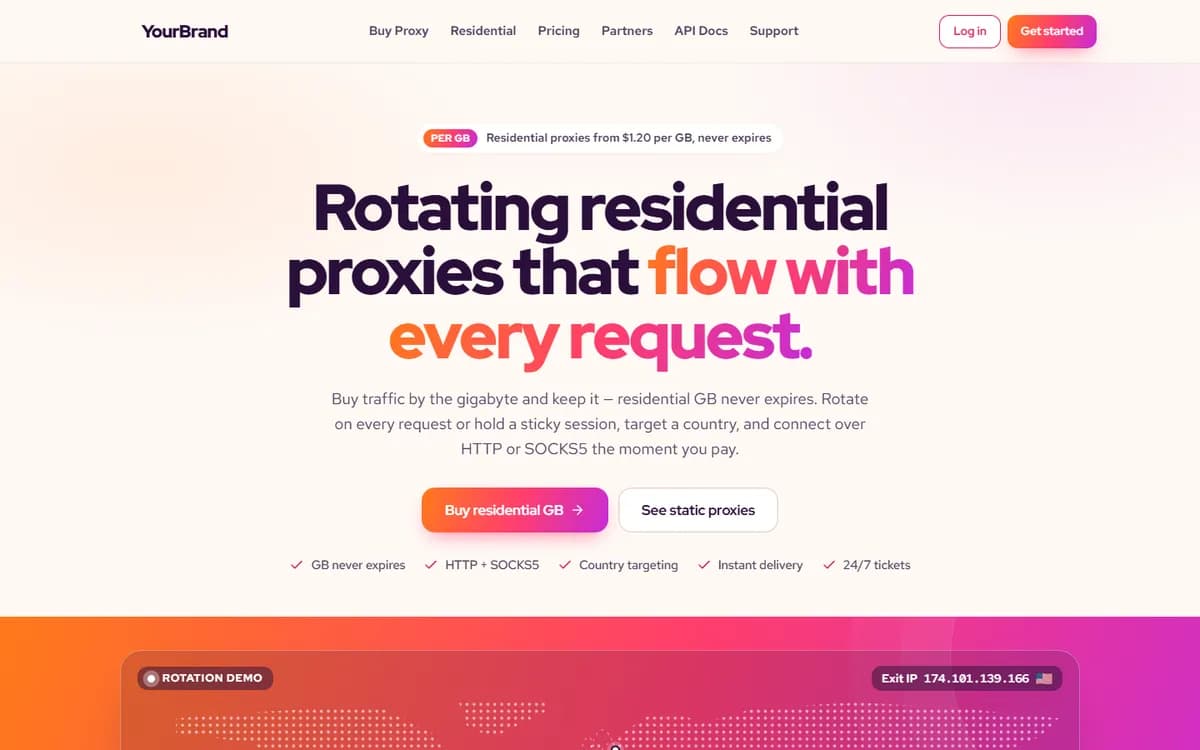
If you’d rather not build it yourself, our Ready-made Proxy Selling Platform sets up a branded storefront on your domain with residential, datacenter and IPv4 products, automatic delivery through your connected provider, a customer dashboard, wallet and payment gateways. It’s a $200 one-time setup with one month of support included, delivered within 10 business days. Your domain, hosting and provider costs are paid separately, so confirm your provider is supported before you order.
Step 5: Set up payments
Most proxy sellers offer cards plus crypto; IPRoyal, for example, accepts major cards, PayPal, Alipay and more than 25 cryptocurrencies. Card processors run risk reviews, and Stripe notes that its restricted-business list is “representative but not exhaustive”, so confirm your model with your processor before you launch. Publish a clear refund policy and decide how you’ll handle chargebacks, because they cost you the bandwidth and the fee.
Step 6: Launch, market and keep customers
Search traffic tends to be the cheapest channel over time: write a page for each use case you serve (price monitoring proxies, SEO proxies and so on), answer questions in the communities your niche uses, and add an affiliate program so happy customers can refer others. To keep customers, send low-balance alerts, offer non-expiring traffic where your provider allows it, and answer support tickets fast.
Launch checklist
Step 1: Pick your niche and proxy types
Decide who you serve and whether you sell per GB, per IP or per port.
Step 2: Vet two providers
Check sourcing, reseller API, CNAME support, minimums and KYC, then integrate a backup.
Step 3: Model your margin
Use real wholesale prices, payment fees, refunds and acquisition costs.
Step 4: Launch your storefront
Automate delivery, usage tracking and top-ups so customers never wait.
Step 5: Publish your policies
Acceptable use, refunds and an abuse contact, at least as strict as your provider’s terms.
Step 6: Start marketing
Use-case pages, community answers and an affiliate program, then measure cost per customer.
A proxy business rewards operators who pick a clear niche, choose ethical suppliers and remove friction from buying. Get those three right and the technology is the easy part.