How to Start an SMM Panel Business in 2026 (Honest Guide)
Start an SMM panel in 2026 the right way: child panel vs own panel, how provider APIs work, real costs and margins, payments and platform-rule risks.
Published 10 min readBy the WestSideAgency team
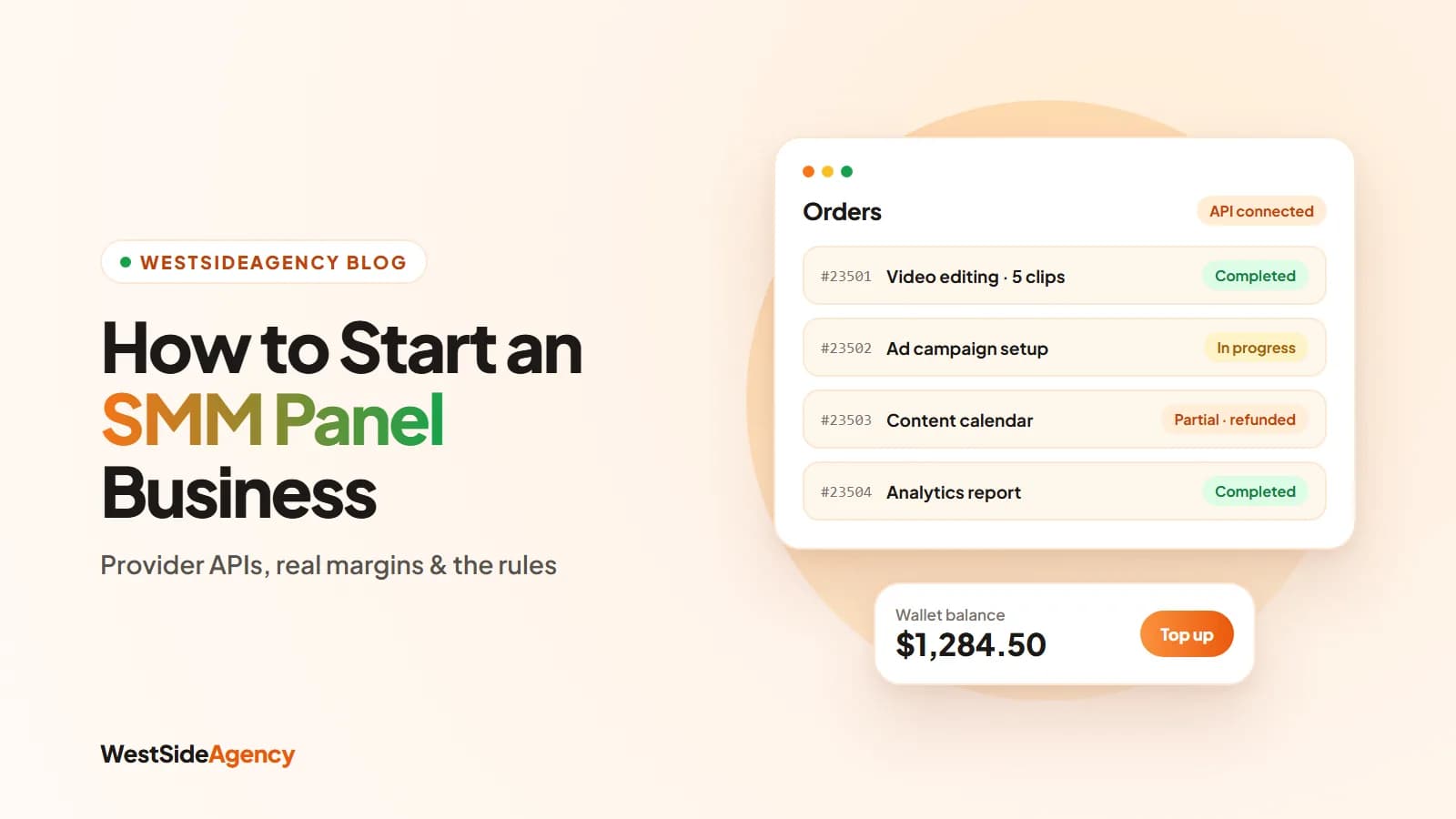
An SMM panel is a website where customers buy social media marketing services, and the orders are passed automatically to a wholesale provider through an API. You set the catalogue and the prices; the provider fulfils the work. This guide explains how panels really work, what they cost, how the margins add up, and the platform rules and laws most “how to start an SMM panel” guides leave out.
What an SMM panel business actually is
There are three players: the provider that fulfils orders, the panel owner (you) who runs the storefront and sets prices, and the customer who places orders and tops up a wallet.
| Route | Control | Setup effort | Who sees your data |
|---|---|---|---|
| Child panel | Low: runs on a parent panel’s system | Very low | The parent panel processes every order |
| Hosted panel platform | Medium | Low | The platform operator |
| Your own branded panel | High: your domain, catalogue and providers | Medium (or done-for-you) | You |
How the SMM panel API works
Most providers follow the same de facto format, popularised by large panels: your site sends a POST request with your API key and an action. The common actions are services (list the catalogue), add (place an order), status (check up to 100 orders at once), balance, refill and cancel.
POST https://provider.example/api/v2
key=YOUR_API_KEY&action=add&service=1024&link=https://instagram.com/p/xyz&quantity=1000

→ {"order": 23501}

POST https://provider.example/api/v2
key=YOUR_API_KEY&action=status&order=23501

→ {"charge": "0.80", "start_count": "3572", "status": "Partial", "remains": "157", "currency": "USD"}
A Partial status means the provider delivered only part of the order. The remains value tells your panel how much to refund to the customer’s wallet automatically.
Check platform rules and the law before you launch
This is the section that decides whether your panel lasts. Read the primary sources yourself:
| Platform or law | What it says |
|---|---|
| Meta (Facebook, Instagram) | Prohibits “selling, buying, or exchanging for engagement, such as likes, shares, views, follows”. |
| TikTok | Prohibits “the trade of services that artificially boost engagement” and removes fake likes and followers. |
| YouTube | Bans “anything that artificially increases the number of views, likes, comments, or other metrics”; artificial traffic isn’t counted and can lead to strikes. |
| US: FTC rule, 16 CFR 465.8 | Since October 2024, bans selling fake indicators of influence (bot, fake or hijacked-account followers and views) that can misrepresent influence commercially. Knowing violations can cost up to $53,088 each. |
| EU: Unfair Commercial Practices Directive | Blacklists false social endorsements, with “likes” on social media given as an example. |
These rules are enforced. In 2019 the FTC settled with Devumi, which had sold fake Twitter followers; its owner was banned from selling social media influence. The same year Facebook and Instagram sued a company that sold fake likes, views and followers. Platforms also remove inauthentic engagement automatically, which is why counts drop and why “non-drop” promises are hard to keep.
Build a catalogue you can stand behind
| Lower risk | High risk |
|---|---|
| Campaign management through official ad tools (Meta ads, TikTok Promote, YouTube/Google Ads) | Bot, fake or hijacked-account followers, likes or views |
| Content creation, video editing, design and captions | Fake comments and reviews |
| Account management and analytics reports | Unverifiable “real, non-drop, guaranteed” claims |
| Disclosed influencer and creator placements | Anything that asks for a customer’s password |
How to start an SMM panel, step by step
Step 1: Pick a niche and a customer
Agencies, local businesses or creators in one language or region. A clear audience beats being the cheapest panel.
Step 2: Choose your setup route
A child panel, a hosted platform, or your own branded panel. If you want your own panel without building it, our SMM Panel setup is a done-for-you option.
Step 3: Secure your site
Use SSL, keep provider API keys on the server only, and turn on two-factor login for admins.
Step 4: Vet and connect providers
Place small test orders, check which services support refill and cancel, and keep a backup provider.
Step 5: Build your catalogue and pricing
Honest descriptions, sensible minimums and markups that cover fees, refunds and support.
Step 6: Set up payments and the wallet
Read your payment processor’s terms first; many panels use wallet top-ups with crypto or local payment methods.
Step 7: Test everything, then launch
Run real orders end to end, including partial refunds and refills, and set a target time for answering tickets.
What it costs to start an SMM panel in 2026
| Item | Typical cost |
|---|---|
| Domain and hosting | From a few dollars a month |
| Panel software | Hosted platforms such as Perfect Panel from $50/month (up to 1,000 orders); or a one-time setup |
| Provider balance | Funds you pre-load with your provider |
| Payment fees | Depends on your gateway; budget a few percent |
| Marketing | Content, communities and ads |
Hidden costs to plan for: refunds on partial orders, refills you honour, and the hours you spend on support.
Is an SMM panel business profitable?
It can be, but the margin is smaller than the headline markup suggests. Here’s an illustrative $10 order where the provider charges $4:
What really moves profit is retention, refund rate, support load and provider reliability, not finding the cheapest supplier. As a reality check, a six-year-old panel listed for sale on Flippa reported revenue of only about $1,300–$1,700 a month from roughly 21,600 users.
Payments and chargebacks
Card processors are cautious about this industry: Stripe’s prohibited list includes “sales of online traffic or engagement”. Visa’s monitoring program flags merchants whose combined fraud and dispute ratio reaches 1.5% from April 2026. Keep disputes low with clear descriptions, delivery logs (start counts and status history), fast ticket replies and no “guaranteed results” claims.
How to stand out
- Serve one niche or language exceptionally well
- Publish transparent refill and refund terms
- Offer bundles of legitimate services, such as content plus ad management
- Give resellers API access or their own child panels
- Promise, and keep, a support response time
Where a done-for-you panel fits
Our SMM Panel setup builds a branded panel on your domain with your own service list and prices, API-provider integration, order tracking and refills, a customer wallet with top-ups and payment gateways. It’s $200 one-time, delivered within 10 business days, with one month of support included and optional support at $50 a month after that. Domain, hosting and API-provider costs are separate, automatic refills depend on your provider, and you choose, and are responsible for, the services you list.