PBN Backlinks in 2026: What They Are, Do They Work, and How Risky Are They?
What PBN backlinks are, what Google's spam policy says, if they still work in 2026, how networks get caught, and how to limit risk.
Published 11 min readBy the WestSideAgency team
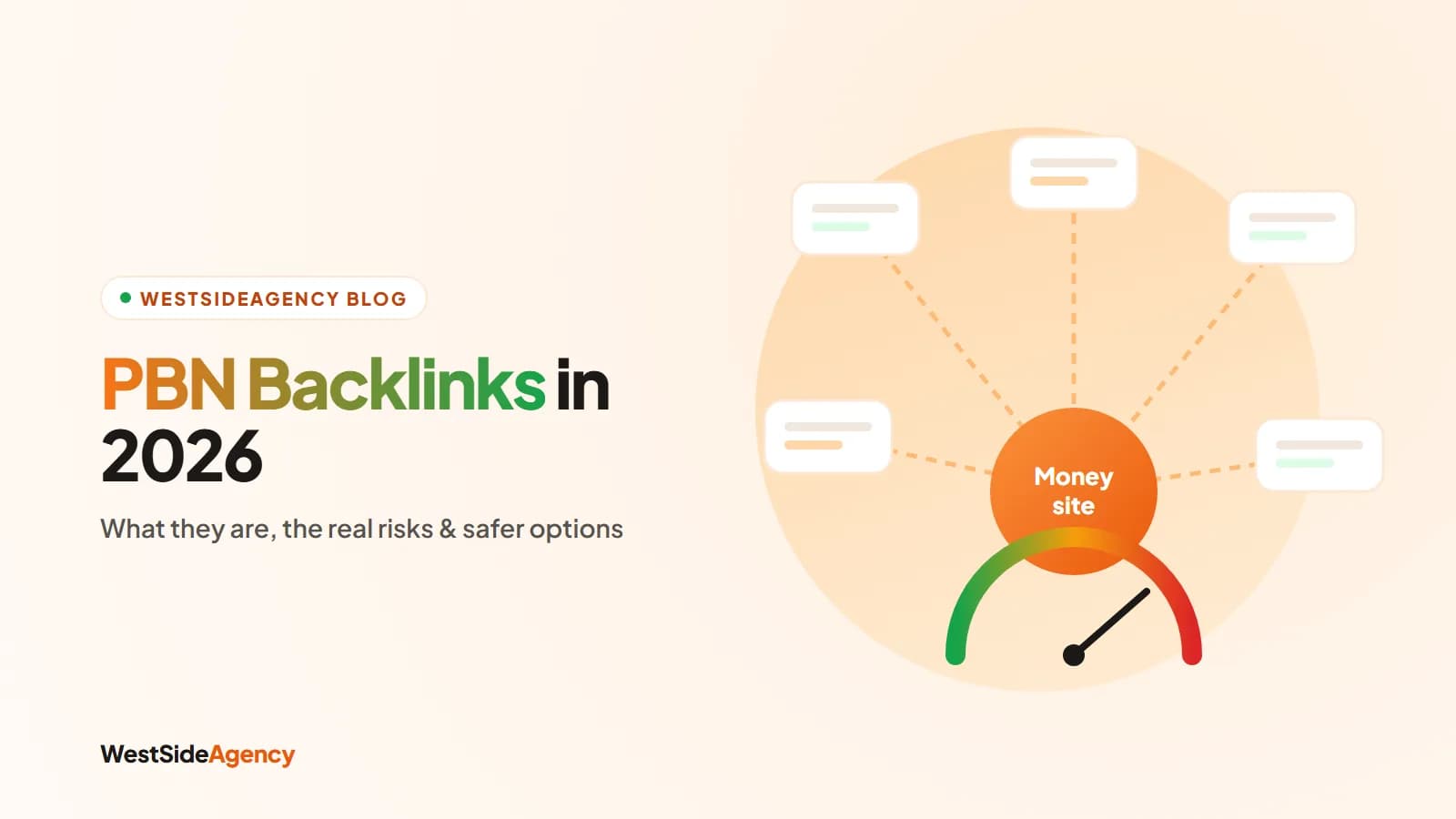
The short answer: PBN backlinks are links from a network of websites controlled by one person or company, usually built on expired domains, whose main job is to pass ranking power to a “money site”. Google’s spam policy covers them as link spam. They can still move rankings for a while, but the most common outcome is that Google quietly ignores the links, and a manual penalty is possible.
What are PBN backlinks?
A private blog network (PBN) is a group of websites that look independent but are owned by one party. The owner places links on those sites pointing to the site they want to rank.
What a “PBN post” is
A PBN post is an article on one of the network’s sites with a contextual link to your page inside the text. It’s generally considered less obvious than a homepage or sidebar link, which appears site-wide.
PBN vs link farm
A PBN tries to look like a set of independent, real blogs. A link farm openly links out to anyone, in bulk, regardless of topic. Google’s policy covers both.
What Google officially says in 2026
Google’s spam policies don’t use the word “PBN”, but the link spam definition covers them directly:
“Link spam is the practice of creating links to or from a site primarily for the purpose of manipulating search rankings.”
The examples Google lists include “exchanging money for links, or posts that contain links” and “creating low-value content primarily for the purposes of manipulating linking and ranking signals”. Google says sites that violate its policies “may rank lower in results or not appear in results at all”, detected “through automated systems and, as needed, human review that can result in a manual action.”
The paid-link exception, and why PBN links don’t qualify
Paid links are allowed “as long as they are qualified with a rel="nofollow" or rel="sponsored" attribute.” PBN links are sold as followed links precisely so they pass ranking power, so the exception doesn’t apply.
Expired domains and AI answers
In March 2024 Google added an expired domain abuse policy, aimed at expired domains “purchased and repurposed primarily to manipulate Search rankings”, which is how most PBNs start. In May 2026 Google also extended its spam definition to cover attempts to manipulate generative AI responses in Search.
Do PBNs still work in 2026?
Links are still a ranking signal and a PBN gives you full control over anchor text, so practitioners do report short-term lifts. None of that is independently measured, though, and Google has been working to neutralise these links for years:
- Since December 2022, Google’s SpamBrain system “can now detect both sites buying links, and sites used for the purpose of passing outgoing links,” with the aim to “neutralize the impact of unnatural links.”
- Google’s spam update documentation says any ranking benefit from those links “cannot be regained.”
- Google’s John Mueller has said PBNs are “pretty obvious to the appropriate tools & basic scripts” (2021), and that “most of those links do nothing, we’ve spent many years ignoring that kind of thing” (2023).
The four real risks
- The links are silently ignored. This is the most common outcome: you pay for links that pass nothing, and you can’t tell from the outside.
- A manual action. Google can flag “a pattern of unnatural, artificial, deceptive, or manipulative links pointing to your site” in Search Console, which can push rankings down until the links are cleaned up and a reconsideration request is accepted.
- The whole network goes at once. Google deindexed the BuildMyRank network in March 2012, and in September 2014 sent a wave of manual-action notices to sites in PBNs. When a network is caught, every buyer is exposed at the same time.
- Repeated spam updates. Google ran spam updates in March, June, August and September 2026, without saying exactly what each one targeted.
How PBN footprints get caught
Networks are rarely caught by one signal. They’re caught by patterns that repeat across sites. A 2019 academic study (“Purchased Fame”, AsiaCCS) built a classifier that identified PBN sites with 98.7% accuracy using content and linking features.
| Footprint | What gives it away |
|---|---|
| Hosting | Many sites on the same IP, subnet, host or nameservers |
| Ownership | Shared or uniformly private WHOIS records |
| Design | The same theme, plugins and layout across sites |
| Content | Thin, spun or off-topic posts written only to hold links |
| Outbound links | Links to many unrelated industries, often with exact-match anchors |
| Traffic | High authority scores but almost no organic traffic |
| Crawler blocking | Blocking SEO tools’ crawlers, which is itself a footprint |
| Domain history | A sudden change of topic visible in the Wayback Machine |
DR, DA, TF/CF: why the numbers can mislead
Sellers usually advertise third-party scores. Ahrefs describes Domain Rating as “purely link-based” and notes it “doesn’t account for backlink spam”; Majestic’s Trust Flow and Citation Flow measure link quality and volume; Moz’s Domain Authority is a prediction score. Google doesn’t use any of them, and all of them can be inflated. Check what matters instead: is the site indexed, does it get real organic traffic, and is it genuinely about your topic?
PBN vs guest posts, niche edits, digital PR and Web 2.0
| Link type | Typical cost | Control | Policy status |
|---|---|---|---|
| PBN post | From about $15–150 per link on marketplaces | High | Link spam if followed and paid |
| Guest post | Average about $295 bought directly (BuzzStream, 2026) | Medium | Paid followed links break the policy; editorial value matters |
| Niche edit | Average about $361 (older Ahrefs sample) | Medium | Same rule as any paid followed link |
| Digital PR | Average about $597 per link (BuzzStream, 2026) | Low | Earned editorial links are what Google wants |
| Web 2.0 profile | Low | High | Mostly brand signals; check each platform’s rel attribute |
The honest point most comparisons skip: a paid, followed guest post or niche edit falls under the same link spam rule as a PBN link. The real differences are editorial value, real readers and how detectable the footprint is.
If you decide to use PBN links anyway
Some site owners accept the risk, often for test projects or sites they treat as experiments. If that’s you, these steps limit the damage:
Step 1: Never point them at sites you can’t afford to lose
Keep them away from your main brand, client sites and health or finance sites.
Step 2: Use only contextual, on-topic posts
On sites that are indexed, have real content and link out sparingly.
Step 3: Keep anchors natural
Mostly brand names, URLs and partial matches, with a short keyword list.
Step 4: Keep them a small part of your profile
Build slowly and mix them with earned links rather than relying on them.
Step 5: Vet the seller and plan an exit
Check sites with a site: search, look for real traffic, ask about removal, and watch the Manual Actions report in Search Console. Use the disavow tool only under Google’s conditions: it’s for “a considerable number of spammy, artificial, or low-quality links” that have caused, or likely will cause, a manual action.
If you’ve weighed this and want a small, controlled set of contextual posts, our PBN post packages come in packs of 1, 10 or 50. Each post is a separate article with your link, you supply the URL and keywords, and delivery takes about 4 business days. For brand properties and link diversity rather than ranking power, see our Web 2.0 backlinks. Neither is risk-free, and we’d rather you know that before you order.
Safer alternatives that build up over time
The links that keep working are the ones people choose to give: digital PR, original data and tools others cite, broken-link building and genuine guest contributions with real editorial value. They’re slower and cost more per link, but they don’t disappear in the next spam update. Our SEO service focuses on that kind of work.